
Criminal Cases in Fresno County Courts
The Superior Court of California, County of Fresno hears the county's felony, misdemeanor, infraction, domestic violence, and criminal collaborative court matters. A prosecutor's formal filing creates the court case, though an indictment can also begin one. The file is not the same as the Sheriff's booking entry or a California Department of Justice rap sheet. Court staff maintain the case number, register of actions, hearing calendar, orders, charge outcomes, and sentence.
The Downtown Courthouse at 1100 Van Ness Avenue is the main criminal location. Its clerk counter is open from 8 a.m. to 4 p.m., and the court's main number is (559) 457-2000. The Fresno Superior Court Criminal Division describes local case types and access routes. The official page shown below marks the right starting point for court-held records.
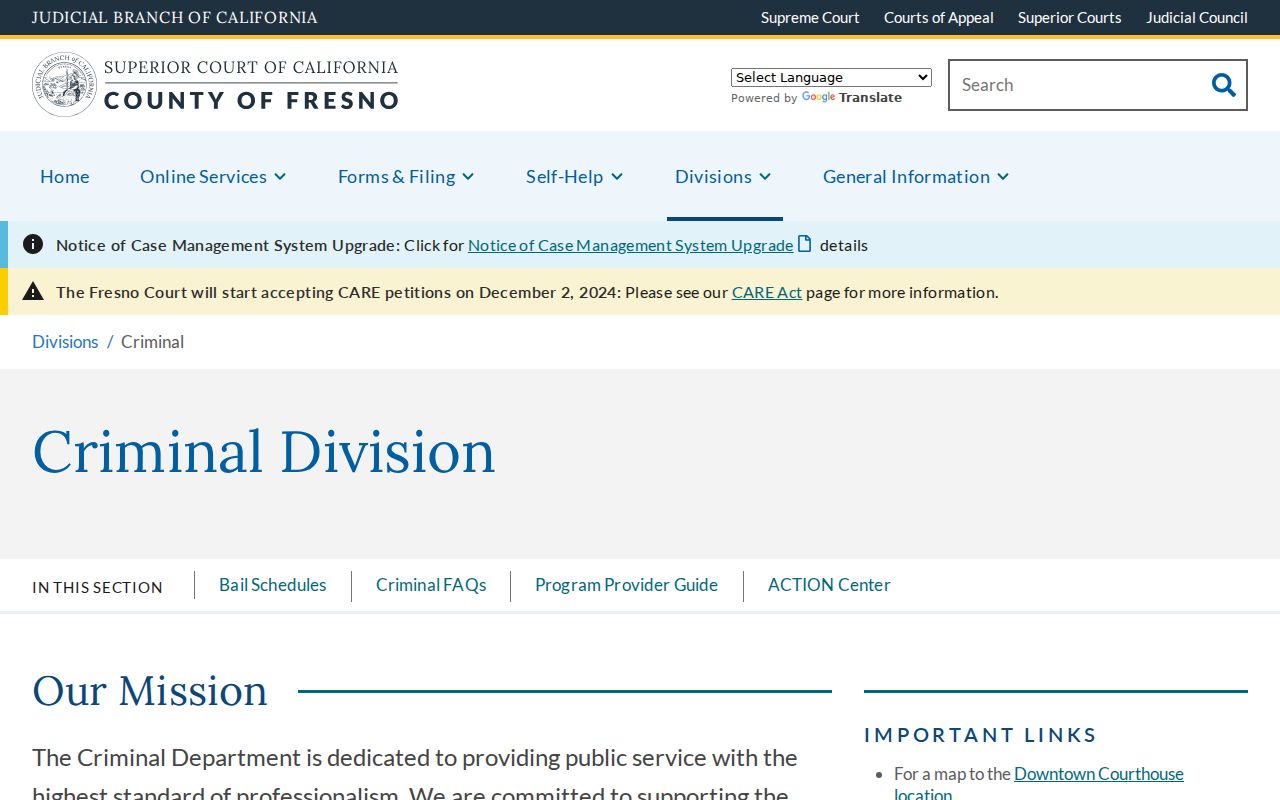
That division page helps separate court procedure from arrest and jail information held by other offices.
Fresno County Criminal Court Locations
Location matters because Fresno County criminal case records are split by function. The Downtown Courthouse location page identifies the main criminal courthouse. Its location record is pictured below.
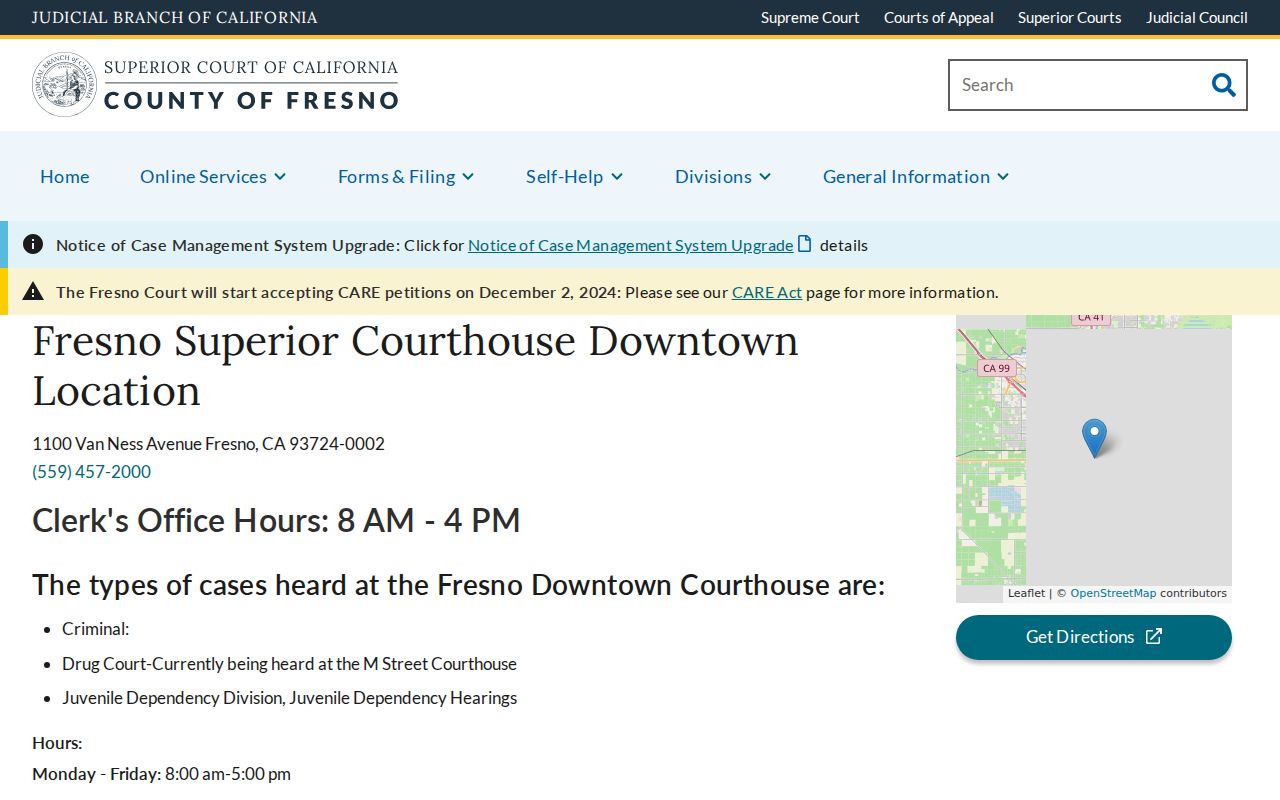
In-custody and domestic violence calendars may run through Jail Annex Departments 95 and 96 at 1265 M Street. Adult collaborative matters use the M Street Courthouse at 2317 Tuolumne Street. After judgment, the ACTION Center at the Downtown Courthouse handles sentencing orders and obligations such as community service, electronic monitoring, diversion programs, drug testing, classes, and fines. Searching the portal first can reveal the assigned department, which tells the reader where to direct a clerk question.
The Jail Annex page documents those two criminal departments.
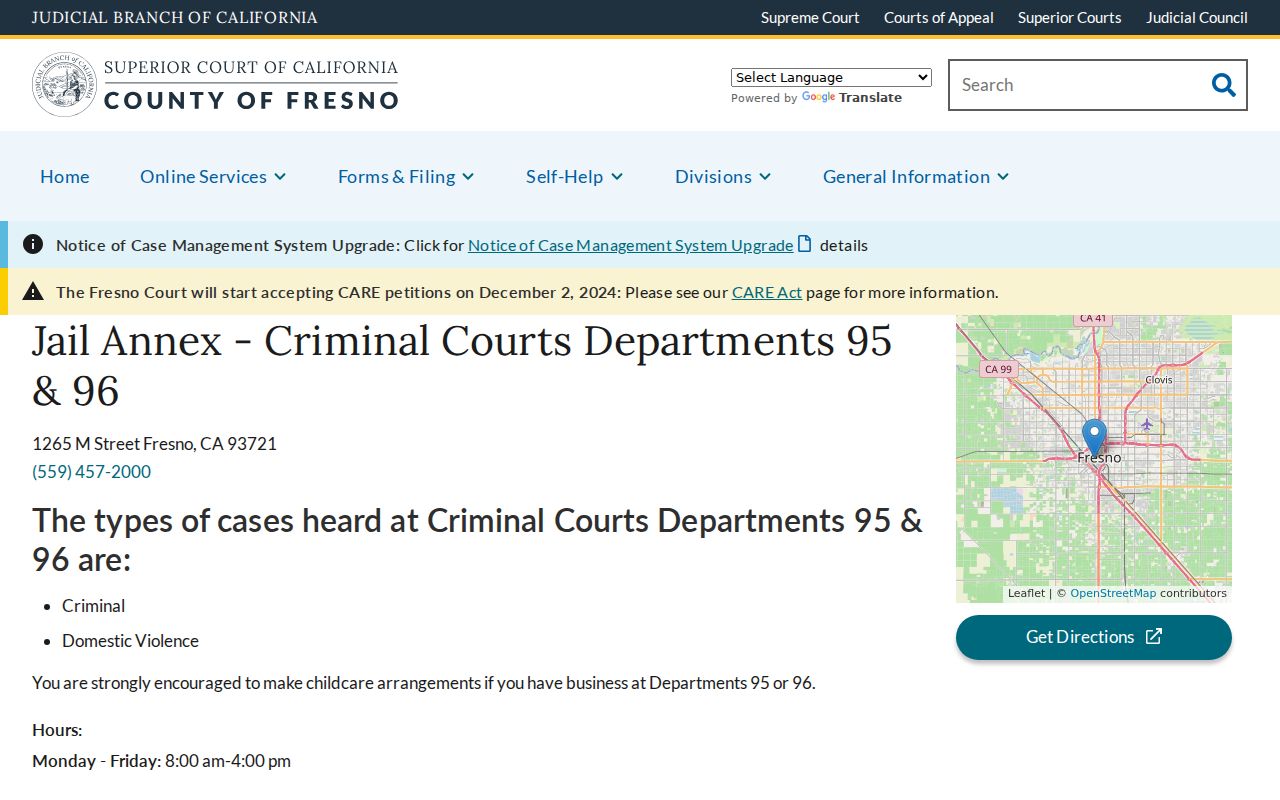
This local split explains why a docket may name M Street or a numbered department instead of the Downtown clerk counter.
How to Search Case Records
Begin with the Fresno Superior Court public portal. Only publicly viewable information appears remotely. A missing result can mean the spelling, court location, filing status, confidentiality rule, or remote-access limit needs more work. Use the clerk for an official copy or a record not exposed through the public view.
- Choose the criminal case search and enter a case number when known.
- For a name search, use the party's last and first names and check close spellings.
- Compare case type, filing date, location, and department before selecting a result.
- Read the register of actions, charges, hearings, and dispositions in date order.
- Ask the criminal clerk for a plain or certified copy when the portal is incomplete.
| Search field | Use | Best practice |
|---|---|---|
| Case number | Direct case match | Keep all letters, digits, and year markers. |
| Last name | Party-name search | Required starting field for most name searches. |
| First name | Narrow results | Try the full name, then a shorter form. |
| Case type | Filter the index | Select the criminal category that fits. |
| Filing year | Separate similar names | Match it to the known event date. |
Certified Fresno County Case Records
A portal screen is not a certified court record. Certification comes from the clerk, who can attest that a copy matches the court file. That difference matters when a reader needs a formal disposition, sentencing order, or other official proof about their own case. Remote criminal document access is limited, so the register may list a minute order even when the document itself cannot be opened.
The Fresno case index ordering page offers another product: monthly case index reports cost $70, with hard copies charged at 50 cents per page plus actual mailing. The image below shows that official ordering channel.
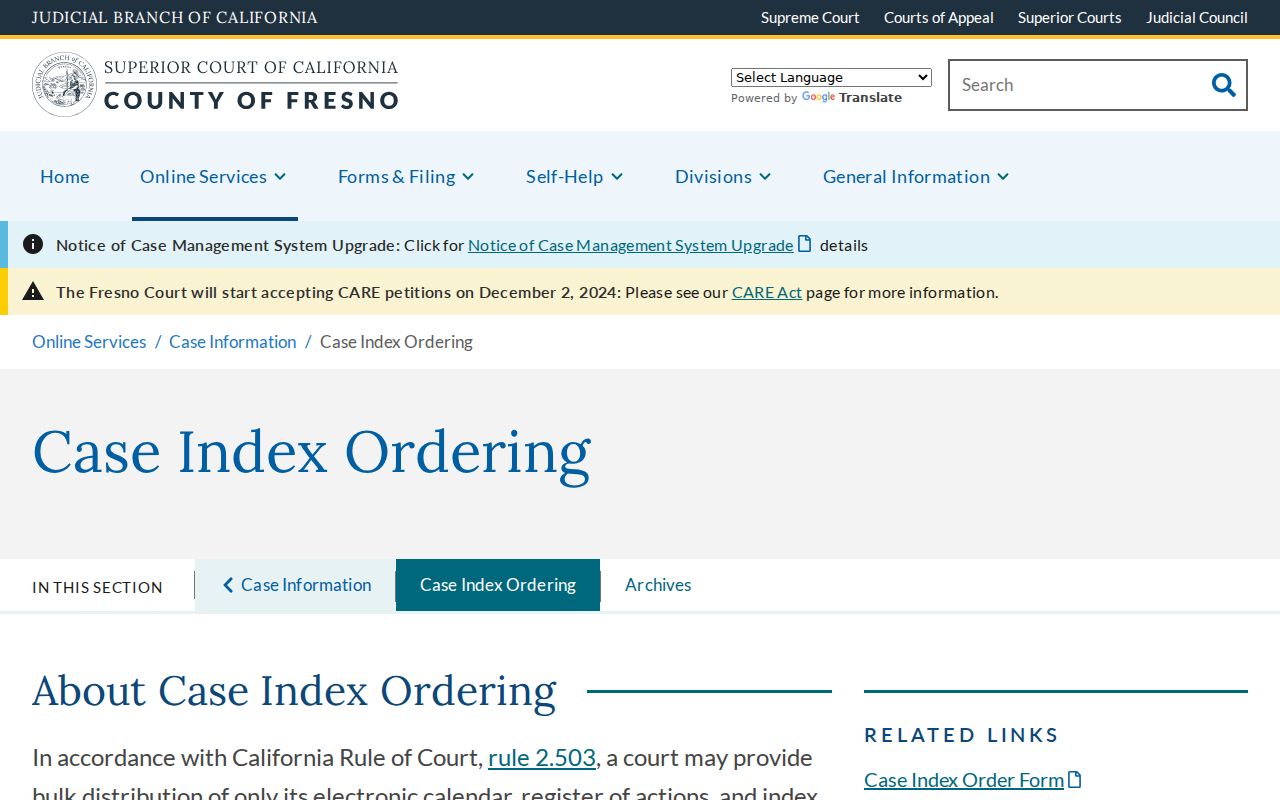
An index identifies cases; it does not replace the filed complaint, order, or certified disposition. Ask the clerk which copy product fits the need.
What the Case File Shows
Fresno County criminal case records tell the procedural story after charges reach court. Read each count separately. One count may be dismissed while another ends in a plea or verdict, and the outcome can change later through a correction or relief order.
| Case number and court | The local identifier, case category, location, and assigned department. |
|---|---|
| Charging document | The complaint, information, or indictment and each alleged statute. |
| Register of actions | A dated list of filings, hearings, warrants, pleas, motions, and orders. |
| Hearings | Dates, times, department numbers, and hearing types. |
| Disposition | The result for each charge, such as conviction, dismissal, or acquittal. |
| Sentence | Custody, probation, fines, restitution, programs, and compliance terms. |
A minute order is the court's short record of what happened at a hearing. A register of actions is the chronological event list. Neither should be read as proof that every allegation led to guilt. The disposition field provides the key outcome.
Older Fresno County Criminal Files
Older case material may move from an active courthouse file to the Fresno Superior Court Archives Facility at 1963 E Street. Archives staff handle storage, record maintenance, and microfilming. The public phone is (559) 457-4903. A portal miss on an old matter does not prove the file never existed. Give staff the case number, party name, approximate filing year, and case type when possible.
The Fresno court archives page identifies this separate records location.
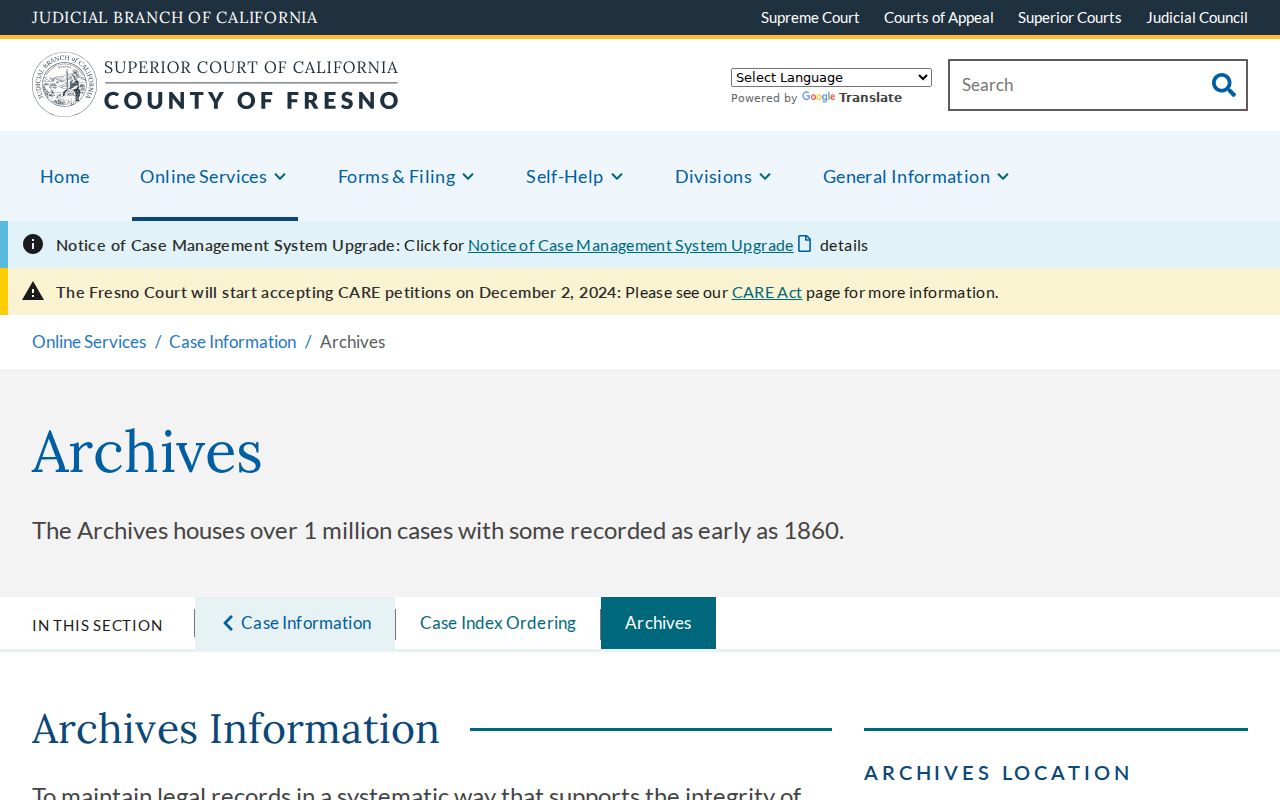
The archive route is especially useful when the public portal supplies only a thin index or no remote document image.
Stages of a Criminal Case
A Fresno County criminal court file grows in stages. For a person held in custody, the court says arraignment must occur within 48 hours of arrest, excluding Sundays and holidays. At arraignment, the judge explains the charges and rights, receives a plea, and may address bail. Pretrial entries then record conferences, motions, discovery disputes, and offers. A plea or trial resolves the disputed charges. The court enters a disposition for each count and, after a conviction, records the sentence.
Case flow: Charges Filed › Arraignment › Pretrial › Plea or Trial › Disposition › Sentencing
The jail entry can precede this flow, but it cannot predict the result. To follow what happened after a Fresno County arrest, use the arrest record for custody facts and the court docket for filed charges and outcomes.
Fresno County Bail Schedule Records
Bail shown in a booking entry and bail ordered in court are related but distinct snapshots. Fresno Superior Court publishes criminal bail schedules organized by statute, offense description, level, and schedule amount. A judge may raise or lower bail at arraignment, and a no-bail warrant or supervision hold may control release. The schedule also warns that listed sums do not represent the total fine a judge may impose at sentencing.
The Fresno criminal bail schedules page provides the current official schedule.
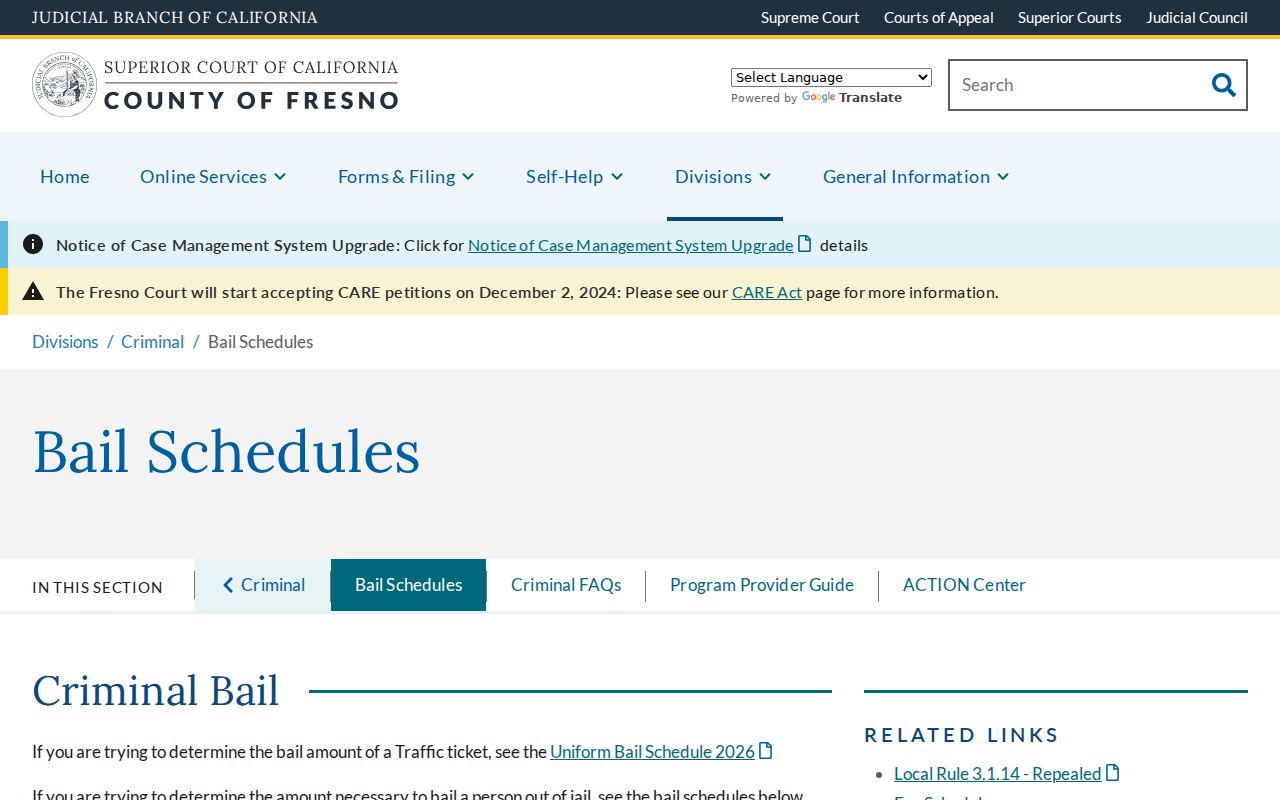
Use the docket and minute order to confirm what the court actually decided rather than treating a schedule or booking amount as final.
Fresno County Collaborative Court Records
Fresno has seven specialty treatment courts: DUI Court, Adult Behavioral Health Court, Family Behavioral Health Court, Mental Health AB1810 Court, Unity Court, Veterans Treatment Court, and CARE Act. Their records still belong to the Superior Court system, but docket entries may show frequent review hearings, supervision, incentives, sanctions, treatment milestones, and program completion.
Adult collaborative matters are associated with the M Street Courthouse, while the collaborative office also lists contacts at 1100 N. Van Ness Avenue. A reader should use the case number and department rather than assume all specialty proceedings occur at the main criminal counter. Sensitive treatment information may be withheld even when a public register confirms that a hearing took place.
Fresno County Case Access Restrictions
California Rule of Court 2.503 supports reasonable electronic access, but it excludes sealed and confidential records and permits limits on remote criminal files. Rule 2.507 governs public calendars, indexes, and registers of actions while protecting confidential details. Juvenile cases, victim information, protected addresses, medical facts, and sealed material are not ordinary public court content. A clerk may provide a public version with redactions or explain why inspection is barred.
The California Public Records Act governs many county and law-enforcement records, but court-file access follows court rules and judicial procedures. Penal Code section 11105 separately restricts California DOJ rap-sheet dissemination. If Fresno County portal data conflicts with a personal DOJ record review, obtain the court disposition and use the DOJ challenge process. The originating court is the best source for correcting missing disposition information.
A portal result can also omit the document image while still listing the event. Note the date, department, and document title before contacting the Fresno County criminal clerk. That detail helps staff locate the right public filing and determine whether a plain copy, certified copy, redacted copy, or in-person inspection is available under the court's rules.